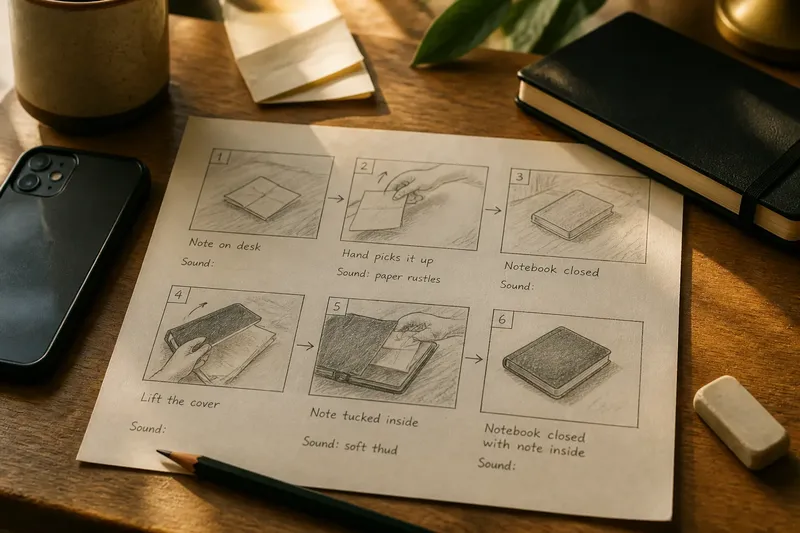
The Prop Pile That Hides the Point
Choose props that change a small video story’s action, context, or result, then arrange them so viewers can follow the choice without extra clutter.
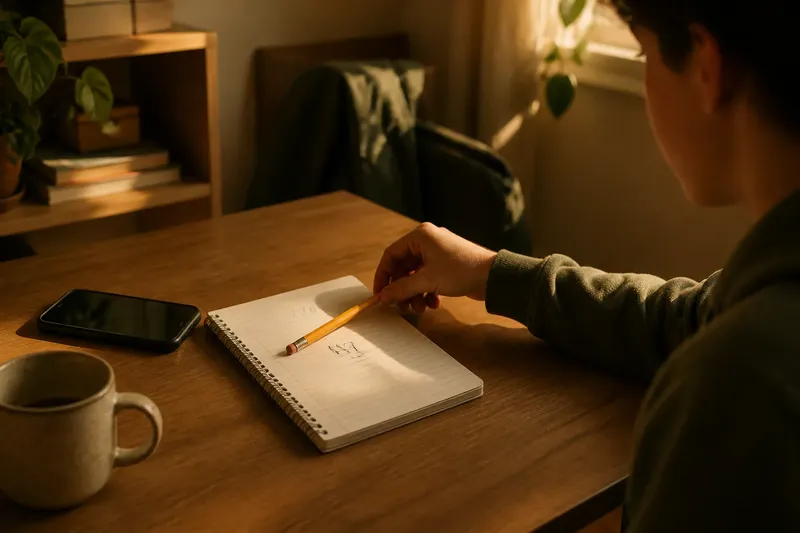
Which props should stay in a small video story? Keep the objects that shape the choice, show useful context, or reveal what changed. A prop can be perfectly clear on its own and still distract if it suggests a second plot the scene never develops.
Build a Prop Motive
Give each object a reason to be in the story. It might be handled, affect a decision, establish a relationship, or show the outcome. Write one sentence describing what changes, then connect every prop to that change.
For a story about someone returning a borrowed pencil, the pencil might be handled, while a notebook bearing its owner’s name explains where it belongs. A decorative mug could make the desk feel lived-in, but it does not help viewers understand the return.
- Action: The character uses or moves the object. Keep it if removing it would alter the visible action; otherwise, try showing the action with a gesture.
- Context: The object clarifies a relationship or situation. Keep it if the scene becomes confusing without it; otherwise, let performance or dialogue supply that information.
- Result: The object’s new place or condition shows what changed. Keep it if that change completes the scene; otherwise, show the outcome through another clear action.
- Decoration: The object adds atmosphere without changing the story. Keep it if it stays in the background; if it draws attention from the action, move it out of frame.
Give Objects Distinct Roles
More than one prop can belong in a scene, but avoid giving several objects the same job. If a character’s decision is already clear through a letter and a hand gesture, a wilted flower and untouched cup may imply additional reasons for the hesitation.
Assign each necessary item a separate role. One object can prompt a choice, another can identify who it concerns, and a third can show the result. If two props explain the same thing, keep the one that fits the action more naturally.
Think of props like labels on storage boxes: a few distinct labels help someone find what they need, while overlapping labels create uncertainty. In a story, let the character’s behavior carry feelings that another object would only repeat.
Plan the Frame Around Meaning
Before filming, place the props where the action will happen and view them through the phone camera. A tabletop that looks orderly to you may make a pencil, notebook, and hand appear crowded together in the frame. Shift the objects until their roles are understandable at a glance, without forcing them into a formal lineup.
Check whether an object’s placement changes what viewers might infer. A key beside a note may read as an invitation to leave; beside a locked box, it may suggest something else. If that second interpretation is not intended, move the object or change what it sits beside.
Say you have a phone, a borrowed pencil, a notebook with a visible name, and a toy on a desk for a scene about returning the pencil. Start with all four objects in frame. Move the toy outside the shot, leave the pencil beside the named notebook, and film the hand placing it there. Watch the clip: if the action now reads as a return rather than a search through a desk, the toy was not earning its place; if the notebook’s name is too small to read, reposition it or let the character turn it toward the camera.
Make the Prop Choice?
Should a prop explain the character’s feelings?
It can, but a repeated clue may create noise rather than meaning. If a gesture already shows reluctance, keep an extra symbolic object only if it adds a distinct part of the story.
Can I use household objects as props?
Yes. Choose items that fit the action and do not introduce distracting labels, personal information, or unrelated associations in the frame.
What if a needed prop is hard to recognize?
Change its placement, angle, or surroundings so its role becomes easier to understand. If viewers still cannot tell why it matters, add a clear action involving it or reconsider whether the story needs it.
How do I know when to remove a prop?
Film the action once, then ask what each object contributes to the decision or outcome. If removing an item would not change what viewers understand, take it out and check whether the scene still makes sense.
Check the Story Logic
Use this prop check before recording. Each answer should lead to a decision, not just another round of tidying.
- If an object is handled during the action, keep it; if it is never touched and does not affect the outcome, remove it or give it a clear story role.
- If an object explains who or what the scene concerns, keep it in view; if viewers can infer that context from the action, move it out of frame.
- If two objects suggest the same relationship, keep the one the character interacts with; if neither is handled, choose the one that gives clearer context or remove both.
- If a prop’s placement implies an unintended choice, reposition it; if no placement makes its meaning clear, change the action or leave it out.
- If a visible object distracts from the decision, move it beyond the frame; if it is necessary to the result, give it a separate, readable place in the action.
- If the outcome depends on an object’s changed position, show the movement; if the change is not needed to understand the ending, let the character’s response carry the result.
Keep the main search phrase, props for a short video story, in mind as you plan: every visible object should support a choice, context, or result. That does not mean stripping a room bare. It means deciding what each object tells the viewer, so a small story can leave the right questions—and answer them through action.